From Lab to Market: A Practical Guide to Commercializing Healthcare Products in the U.S.

UPS Healthcare • July 31, 2026 • 6-minute read
What emerging manufacturers need to know about compliance, logistics, and market strategy before their first order ships.
Authors: Anthony Paquin, Vice President, iRemedy & Kranti Sharma,
Senior Manager, UPS Healthcare
You’ve done the hard part. Your product is ready, your clinical data is robust, and the FDA has granted its approval. Now comes the question that catches many healthcare companies off guard: how do you get your product into the hands of the providers and patients who need it?
For large pharmaceutical and medical device companies, the answer is straightforward -they have entire departments dedicated to distribution, regulatory compliance, and supply chain operations. But for small and mid-sized manufacturers, the path from regulatory approval to commercial distribution is often far more complex than expected. It’s a gap that can stall promising products for months or even years.
This guide is designed to help emerging healthcare companies understand what commercialization in the U.S. healthcare market involves -the infrastructure, the compliance requirements, and the strategic decisions that separate products sitting in a warehouse from products making a difference in clinical settings.
Increasingly, companies are addressing this challenge by leveraging partners that combine compliant distribution infrastructure with procurement access and digital enablement -such as the integrated model provided by UPS Healthcare and iRemedy.
The Challenges of Healthcare Commercialization

Getting a product to market in healthcare is fundamentally different from other industries. You can’t simply list a medical device on an e-commerce platform or ship pharmaceuticals through a standard fulfillment center. Healthcare distribution operates within a tightly regulated ecosystem that touches federal law, state licensing, quality systems, and institutional procurement rules.
The challenge for emerging companies isn’t just building a great product. It’s building, or accessing, the infrastructure required to distribute it legally, reliably, and at scale. That infrastructure typically includes wholesale distribution licenses across multiple states, Drug Supply Chain Security Act (DSCSA) compliance for serialization and traceability, FDA and DEA registrations depending on product classification, cold chain logistics capabilities for temperature-sensitive products, healthcare-grade warehousing that meets Good Distribution Practice (GDP) standards, and technology systems for order management, credentialing, and compliance documentation.
For context, assembling this infrastructure independently can take 12 to 24 months and cost well into seven figures. Many promising products never reach the market - not because of quality or demand, but because the commercialization runway is too long and too expensive.
The Five Essentials for Healthcare Product Success
While every product and company is different, successful U.S. market entry generally requires attention to five core areas. Understanding these early can save significant time and capital.
1. Regulatory Readiness
Before shipping a single unit, your regulatory house must be in order. This goes beyond FDA clearance or approval. Depending on your product, you may need:
- DEA registration for controlled substances.
- State-level wholesale distribution licenses (requirements vary significantly by state).
- Proper product classification and labeling that meets federal requirements.
- DSCSA compliance for serialization and traceability of pharmaceuticals.
The regulatory landscape is not static. For example, DSCSA, is moving toward full electronic interoperability. Smaller manufacturers often underestimate the ongoing investment required to maintain compliance, this isn’t a one-time checkbox but a continuous operational commitment.
2. Logistics and Fulfillment Infrastructure
Healthcare logistics is a specialized discipline. Standard third-party logistics providers are rarely equipped to handle the requirements of pharmaceutical or medical device distribution. Your fulfillment operation must support:
- GMP and GDP-compliant warehousing.
- Temperature-controlled storage and shipping (ambient, refrigerated, frozen, and cryogenic).
- Lot and expiration date tracking with full traceability.
- Hazardous materials handling (if applicable).
- Reverse logistics for returns, recalls, and quarantines.
The good news is that you don’t necessarily have to build this yourself. Through partnerships with organizations like UPS Healthcare and iRemedy, manufacturers can access licensed distribution frameworks, order management technology, and healthcare market connectivity without standing up those capabilities internally.
The healthcare logistics industry has matured significantly, and established providers can offer compliant infrastructure as a service, allowing manufacturers to focus on what they do best.
3. Technology and Data Systems
Modern healthcare procurement runs on data. Hospitals and health systems expect:
- Electronic ordering and real-time inventory visibility.
- Automated compliance documentation.
- Structured product data that integrates with their own systems.
At a minimum, emerging manufacturers should be prepared to support digital catalogs with complete product metadata (NDC, UDI, HCPCS codes, lot and expiration data), electronic order processing and fulfillment tracking, DSCSA transaction documentation for pharmaceuticals, and integration capabilities with common healthcare procurement platforms.
Building these capabilities from scratch is resource-intensive, but there are technology platforms purpose-built for healthcare distribution that can dramatically accelerate time to market. For example, iRemedy’s AI-driven procurement and compliance environment integrates seamlessly with provider purchasing workflows.
4. Market Access and Sales Channels
An FDA-cleared product and compliant distribution infrastructure is necessary, but not sufficient. You also need a strategy for reaching buyers. Healthcare procurement is relationship-driven, and the sales cycle can be long, particularly with institutional buyers.
Key channels to consider:
- Direct-to-provider sales (targeting physician practices, clinics, and ambulatory surgery centers).
- Health system and Integrated Delivery Network (requires credentialing and group purchasing organization alignment).
- Government procurement (GSA schedules, VA/DoD channels, and emergency preparedness programs).
- Specialty pharmacy and retail distribution for applicable products.
Each channel has its own requirements for credentialing, pricing, and compliance. Many emerging manufacturers find success by starting with a focused channel strategy, building a track record with smaller accounts before pursuing large health system contracts.
5. Financial and Operational Planning
Commercialization is a capital-intensive phase. Beyond the obvious costs of inventory and logistics, companies should plan for the time gap between shipping products and collecting payment, the cost of maintaining regulatory compliance across multiple states, customer support and account management resources, and insurance, bonding, and working capital requirements specific to healthcare distribution.
A realistic financial model that accounts for these factors is essential. Undercapitalization during the commercialization phase is one of the most common reasons promising healthcare products fail to achieve commercial traction.
Common Mistakes to Avoid
Having worked with companies across the healthcare supply chain, we’ve seen a few patterns that consistently cause problems for emerging manufacturers.

The Case for Partnership Over Going It Alone

The healthcare supply chain has historically been structured to favor large, established companies. The barriers to entry including licensing, logistics, technology, compliance create a significant advantage for incumbents and a significant challenge for newcomers.
But that’s changing. A new model is emerging where manufacturers of all sizes can access enterprise-grade infrastructure through strategic partnerships, rather than building it themselves. This model allows emerging companies to get to market faster, often in weeks rather than months; maintain focus on product development and clinical value; reduce the capital required for commercialization; and leverage established compliance frameworks and quality systems.
The key is finding partners who understand the unique demands of healthcare logistics - partners with the regulatory expertise, the physical infrastructure, and the technology platforms to support compliant, scalable distribution.
This is exactly the model behind the Incubator Solution from UPS Healthcare and iRemedy. Designed specifically for emerging and mid-market healthcare manufacturers, the program provides turnkey access to UPS Healthcare’s global distribution network - including cold chain capabilities, healthcare-compliant warehousing, and last-mile delivery - paired with iRemedy’s patented AI-powered platform that connects manufacturers to credentialed healthcare buyers, manages compliance documentation, supports order-to-cash workflows, and enables access to government and institutional purchasing channels.
Rather than spending years and millions building internal logistics, compliance, and sales operations, manufacturers can plug into an infrastructure that’s already built, licensed, and has established trust with health systems and government buyers nationwide.
The program has been onboarding its first cohort of participating manufacturers, with a growing pipeline of companies across pharmaceuticals, medical devices, laboratory diagnostics, and specialty products. It’s a practical proof point that the “partnership over building” model isn’t theoretical, it’s operational and scaling today.
Looking Ahead
The importance of healthcare supply chain resilience has never been more apparent. Recent years have exposed the vulnerabilities of concentrated, globally dependent supply chains, from API shortages to device delivery delays. As a result, there is growing momentum behind reshoring and near-shoring initiatives, and increasing demand for diverse, reliable domestic suppliers.
For emerging manufacturers, particularly those producing products domestically or diversifying supply away from single-source dependencies, this represents a significant opportunity. Health systems and government buyers are actively seeking new suppliers who can provide quality products through resilient, transparent supply chains.
The manufacturers who can pair strong products with reliable, compliant distribution will be best positioned to capture this opportunity.
For more information about this solution and how UPS Healthcare can meet your logistics needs, contact our team.
More Blogs

Guide to Medical Device Management
A single gap in your medical device supply chain could put care at risk. This guide shows you how to close those gaps fast, from device lifecycle management to real-time visibility and reverse logistics.
Delivering Advanced Cancer Therapies in Asia
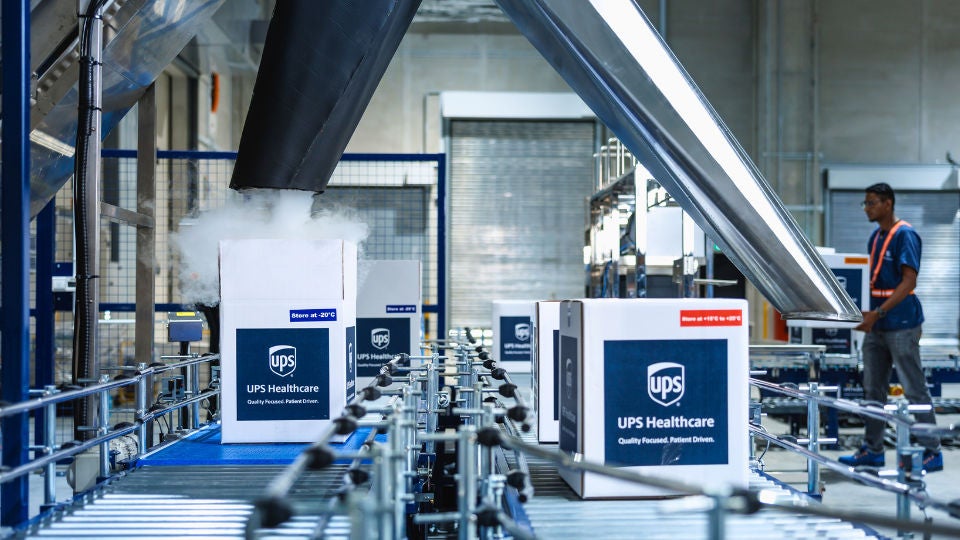
As demand for Antibody-Drug Conjugates (ADCs) grows across Asia, UPS Healthcare supports their safe and efficient delivery through advanced logistics infrastructure, cold chain solutions, and expertise.

How Healthcare Logistics & Distribution Powers Pharma Success
Learn how the right supply chain strategy helps pharma and biotech deliver delicate products reliably and efficiently, turning logistics into a competitive advantage.