Faster Retail Fulfillment: New Research from UPS
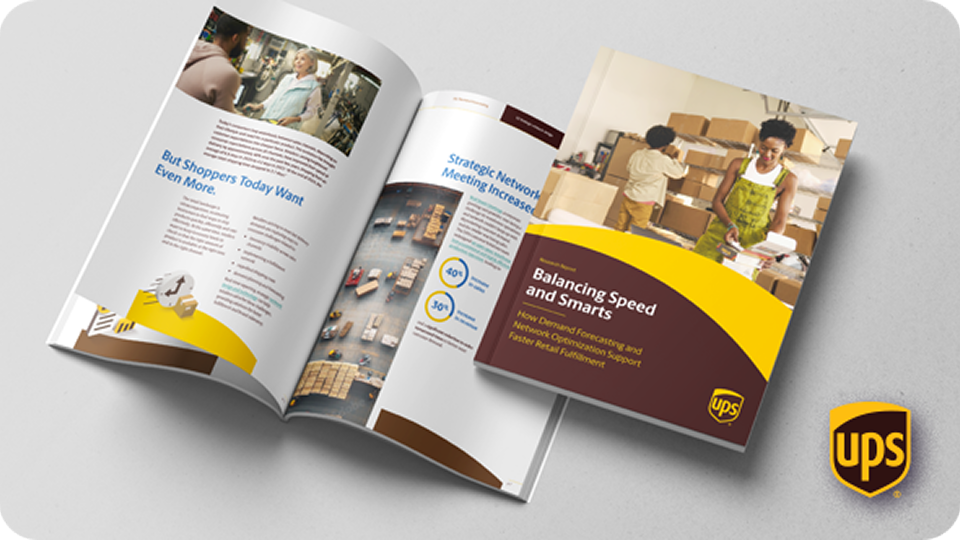
Download the latest retail fulfillment report from UPS to discover how demand forecasting, network optimization and AI can improve retail fulfillment speed and lower costs.
May 5, 2026 • 7 minute read
Author: Phyllis Jackson, Senior Manager, US Marketing, UPS
Balancing Speed and Smarts: Faster Retail Fulfillment
Download the full report to learn ways to:
Research and Insights from UPS
Consumer expectations for product choice, availability and delivery options continue to evolve. To meet these growing expectations, retail fulfillment solutions have become incredibly complex. Today’s retailers must deliver products faster than ever without inflating their fulfillment and delivery costs.
Consider the current landscape of consumer expectations:
- 46% of retail customers will abandon a purchase if shipping times are perceived as too long or if no estimated shipping time is provided.¹
- 9 out of 10 consumers say they will abandon an online order if they feel shipping costs are too high.¹
- The average consumer wants their order to arrive in three days or less.²
- 50% of consumers say they do not want to pay anything for shipping, regardless of how quickly their order is delivered.²
- 77% of consumers report that free shipping directly impacts their purchasing decision.³
Shoppers expect the complete package: exceptional products, a frictionless delivery experience and fast shipping times.
Further, today’s consumers hop seamlessly between sales channels. They move from in-store to online shopping channels depending on their lifestyle needs and the particular product they’re looking for. This means that consumers’ heightened expectations for delivery span all channels. In response, retailers have improved delivery speeds by approximately 40% over the past few years, dropping from an average of 6.6 days in 2020 to 4.2 days in 2023.² By the end of 2024, the average retail shipping time had dropped to just 3.7 days.⁴
The retail landscape remains ultracompetitive, giving consumers a wealth of options in a heavily omnichannel environment. In order to stay competitive without sacrificing margins, retailers must learn to carefully balance delivery speed, delivery optionality and total fulfillment costs.
Looking for a dive deeper into the data? Click here to download the full research report from UPS, "Balancing Speed and Smarts".
Demand Forecasting Enables Flexible Retail Fultillment
For shoppers, the desired timeline between product discovery, purchase and delivery continues to shrink. In order to stay competitive, retailers must evolve their delivery strategies to accommodate faster fulfillment and more options to their shoppers like:
- Buy online and pick up in store (BOPIS): Click-and-collect sales are projected to reach $335.9 billion by 2030.⁵
- Buy online and pick up anywhere: Using alternate pickup locations adds convenience.
- Buy online and return in store (BORIS): Simplifying the returns process boosts customer loyalty.
- Buy in store, ship from another location: Saving the sale when an item is out of stock locally.
To meet these robust omnichannel fulfillment expectations, retailers can leverage real-time forecasting. This approach uses historical sales, current sales, shipment patterns and returns data. It also incorporates market and economic trend data to predict demand accurately and adjust inventory levels as needed.
Advanced, real-time forecasting methodologies and technologies continuously incorporate new information. Harnessing this data allows businesses to respond quickly to sudden changes in demand and optimize inventory levels. It empowers operations teams to be agile, accurate and responsive. Physical retail stores can leverage this cross-channel visibility to optimize stockroom inventory. Managers can schedule staffing to more accurately accommodate shipping and pickup demands, plan for peak season surges and execute smarter hiring strategies.
Investing in Inventory Optimization
Inventory optimization is all about having the right products in the right place at the right time and balancing product availability with profitability. Often, retailers facing costly operational hurdles can benefit from rationalizing their product catalog at the SKU level. Sunsetting slow-moving or inactive SKUs can significantly decrease inventory carry costs.
However, many businesses have limited resources, staffing and expertise to accurately analyze their catalogs and optimize their inventory. Some brands may rely on manual inventory tracking methods, which cab introduce time constraints and the possibility of costly human error. More frequently, inventory tracking is spread inefficiently across online platforms, physical retail stores and disparate warehouse locations. A logistics partner can help implement inventory forecasting and optimization techniques using a crawl, walk, run approach. Consultants act as matchmakers between retailers and vetted third-party providers. They find the inventory planning and management system that works best with the tools and software a retailer already has in place.
For retailers operating physical stores, anticipating demand and mitigating stockouts can heavily buoy in-person upselling opportunities. Research shows that 37% of shoppers who visit a physical store to pick up an online order will make additional unplanned purchases once in the store. During peak holiday seasons, that number jumps to a staggering 86%.⁶ With a clearer picture of demand, retailers can make strategic inventory decisions to get products in front of customers at just the right time.
Proximity Matters: Micro and Regional Fulfillment Centers
Micro fulfillment centers and regional fulfillment centers act as small warehouses for nearby physical stores. They enable a business to execute highly flexible last-mile strategies and effectively avoid stockouts.
Using micro fulfillment centers heavily shortens shipping zones. It speeds up delivery times to customers, drastically lowers shipping costs and enhances the overall customer experience. Advancements in automation technology and the reduced cost of management software allow small- and medium-sized retailers to ship directly from the store or the micro fulfillment center. This helps them compete aggressively with larger retail giants. Industry experts expect 7,300 automated micro-fulfillment centers to be installed by 2030.⁷
Smaller retailers must carefully weigh the advantages and related costs of finding a warehouse, buying it and staffing it independently versus contracting with a third-party logistics (3PL) firm. While 3PLs offer convenience, they often require minimum inventory volumes that smaller retailers might struggle to meet without spreading their capital thin. Analyzing the fulfillment network identifies key areas for new efficiencies, faster shipping times and deeply reduced costs.
Retail Fulfillment Technology Powers Omnichannel Strategy
Modern retail supply chains are enabled by complex tech stacks that automate and optimize functions from inventory forecasting to shipping visibility to omnichannel delivery orchestration. These are some of the ways retailers are leveraging fulfillment technology to optimize their operations.
Artificial Intelligence Powers Real-Time Forecasting
Artificial intelligence (AI) tools assist heavily with real-time forecasting. These tools are able to integrate large data sets quickly and effectively across multiple sales channels. Retailers use AI to merge e-commerce data—like search queries and abandoned carts—with in-store sales data and macro information like inflation rates or seasonality.
This deep insight helps retailers optimize inventory perfectly between online and in-person shopping channels. It allows them to adjust prices dynamically and streamline workforce staffing. Recent research reveals that 89% of retailers either currently use AI in their operations or actively research how to implement it. Among those already using AI, 87% report the technology has a positive impact on their annual revenue.⁸ Furthermore, retailers can see potential cost savings between 20% and 30% when they use AI automation to assist with complex supply chain forecasting.⁹
Digital Twins Enable Quick Pivots
Simulations help retailers visualize operational changes before committing resources to meet customer demand. Digital twins—virtual replicas of physical operations—allow operations managers to test a new process in a safe digital environment before making real-world physical changes.
While a digital twin requires expertise to implement, it offers an incredible way to quickly experiment and learn. Retailers use digital twins to visualize physical store layout changes and assist with inventory management to completely avoid overstock situations or stockouts. Research shows that retailers using a digital twin cut product delays and operational downtime by 50% to 80%, while boosting forecasting accuracy by 20% to 30%.¹⁰
Major logistics providers use digital twins to increase package reliability. By simulating what-if scenarios like severe weather events or sudden demand surges, teams determine the most efficient and cost-effective solutions to reduce friction and ensure packages reach customers on time.
Delivery Options at Checkout Drive More Conversions
Remaining competitive in retail takes more than just developing great products. You must also offer customers the specific delivery options that fit their lifestyles and the shipping speeds that meet their needs and budgets. There is a direct line between meeting customer expectations and improving conversion rates. A great delivery experience naturally keeps shoppers coming back for more.
Providing reliable, affordable and fast shipping builds vital connection and goodwill with your audience. Connected consumers expect seamless experiences regardless of whether they shop online or in a physical store. Retailers must think strategically across sales channels, geographic regions and their entire supply chains.
Retailers are prioritizing innovative solutions to improve delivery speeds and are investing in necessary infrastructure upgrades to optimize their operations without shutting down existing workflows. Striking the right balance of speed, convenience and operational cost will help today’s retailers compete in a demanding and complex omnichannel retail environment.
Ready to transform your supply chain? Download the full research report for comprehensive strategies, detailed case studies and actionable steps to optimize your retail fulfillment network today.
1. “Same-day delivery: Ready for takeoff,” McKinsey, accessed July 13, 2025.
2. “What do US customers want from e-commerce deliveries?” McKinsey, accessed July 13, 2025.
3. “The Longest Mile: 2025 Home Delivery Report,” Alix Partners, July 2025.
4. “Last mile peak season performance,” Project44, December 4, 2024.
5. “Buy Online Pick Up In Store (BOPIS) Statistics,” Capital One Shopping, accessed July 17, 2025.
6. “Why physical stores are still vital for retail,” LS Retail, January 20, 2025.
7. “7,300 automated micro-fulfillment centers to be installed by 2030,” Interact Analysis, accessed July 13, 2025.
8. “State of AI in Retail and CPG,” Nvidia, Accessed July 15, 2025.
9. “Generative AI for retail: options and costs for 2025,” Sommo, accessed July 13, 2025.
10. “How Will Digital Twins Software Transform Your Business in 2025?” Simio, accessed July 13, 2025.
Individual results and options will vary. UPS makes no promises of any specific outcome in this document but instead provides only example outcomes based on certain UPS customer experiences.