The Circular Economy and Sustainable Manufacturing
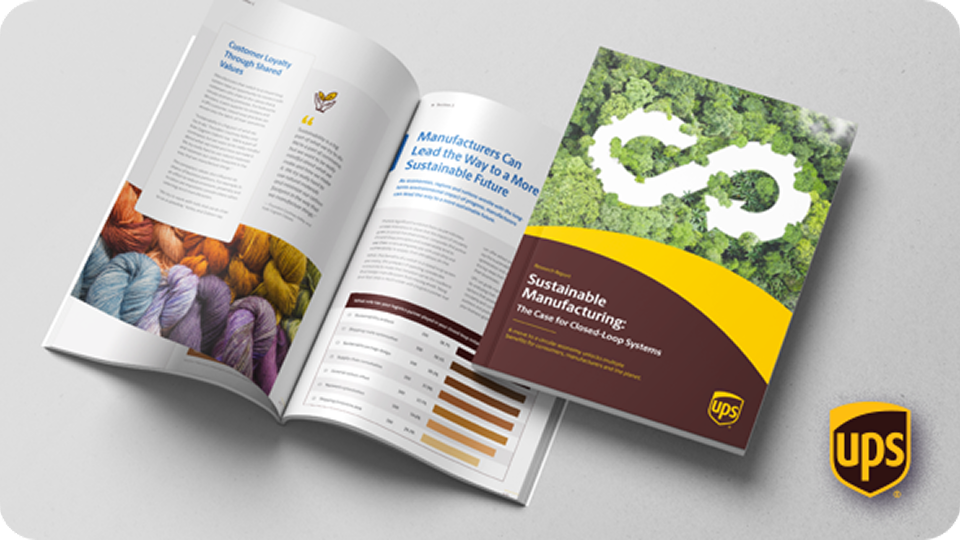
Download the circular economy research report from UPS to learn why more manufacturers are implementing closed-loop manufacturing practices.
June 16, 2026 • 7 minute read
Author: Phyllis Jackson, Senior Manager, US Marketing, UPS
The Circular Economy and Sustainable Manufacturing
Download the full report to learn:
A More Sustainable Way to Manufacture
The traditional linear approach to manufacturing is not only less environmentally sustainable, it also leaves manufacturers vulnerable. It leaves them dependent on a constant supply of new raw materials, and shifts in resource availability, geopolitical instability and price fluctuations can cause significant disruptions in the supply chain.
Survey results from the UPS Circular Economy report and additional industry research highlight the initiatives manufacturers are prioritizing as they adapt to a new circular economy. By embracing closed-loop manufacturing, what was once overlooked as waste can be become a competitive advantage create a shift towards a more sustainable way of manufacturing.
The Origins of the Circular Economy
The idea of a circular economy is not new. In the 1970s, Swiss architect and economist Walter Stahel reimagined the industrial process as "cradle to cradle." This philosophy proposed that products should be returned to the production system for reuse rather than being discarded.
Stahel continued his work in the 1980s, founding the Product Life Institute to focus on closed-loop manufacturing systems. His approach was supported by a product-as-a-service business model and four core principles:
- Extend the life of products
- Create products that can be reused
- Repair products instead of throwing them away
- Prevent waste
Influenced by these principles and other approaches like biomimicry, industrial ecology and regenerative design, many manufacturers are beginning to adapt their supply chains to more closed-loop systems. According to UPS research, 50.3% of respondents are implementing closed-loop processes, with another 34.2% planning to do so in the future.*
This shift shows a growing awareness of sustainable business practices as a driver of success. Closed-loop manufacturing practices can lead to lower unit costs, material savings and an overall reduction in waste and emissions. Download the report for more insights into how manufacturers are measuring success of the circular economy.
Lower Unit Costs
An emphasis on reusing materials and resources may reduce production costs over time, leading to a lower cost per unit. For example, implementing closed-loop manufacturing operations how been shown to save up to $700 billion annually for fast-moving consumer goods like household cleaning products and up to $630 billion annually for medium-lived products like cellphones and washing machines.1
Materials Savings
Closed-loop manufacturing systems challenge manufacturers to reduce their reliance on raw materials in favor of renewable or recycled materials. Companies are often pushed to find suitable replacements for virgin materials or implement technology that converts waste into usable resources.
Take for example the advancement in steel manufacturing. Electric arc furnaces (EAFs) are a growing alternative to traditional blast furnaces because they allow manufacturers to use 100% recycled steel. EAFs melt scrap metal while producing up to 71% less carbon dioxide. They also have lower upfront costs, smaller footprints and faster production times.
Waste Reduction and Reuse
In traditional manufacturing operaions, waste was seen as an unavoidable part of doing business. In the circuclar economy, waste can become an opportunity bring materials back into the production cycle.
"Finding ways to return production materials and waste back into the manufacturing cycle helps companies reduce their material costs, and reduces what they pay for waste disposal, too,” says Lorie Schlatterer, Strategic Lead at UPS. “And that ability to recycle material and use it again can dramatically include profits.”
Emissions Reduction
Manufacturing accounts for a significant portion of all greenhouse gas emissions. The principles of a circular economy can play a vital role in reducing this impact. UPS survey data revealed that 27.5% of respondents cited reduced greenhouse gas emissions as a key measure of success for their closed-loop initiatives.**
In the tech industry, for example, remanufactured laptops produce only a fraction of the carbon dioxide emissions of new ones.2
How Manufacturers Are Launching Closed-Loop Systems
Switching from a linear to a circular system requires a well-planned effort. Research from UPS reveals that of manufacturers that plan to implement a closed-loop manufacturing system, 47.6% expect to do so in the next two years.*** For those who have already started, 51.2% cite cost as the biggest challenge.****
For manufacturers looking to make the pivot to a circular economy, there are six steps to consider implementing.
Step 1: Understand Your Current Manufacturing Status
Begin with an internal audit to analyze how materials are acquired and used, the current lifespan of your products and your existing business model. A thorough understanding of your starting point will help you plan your transition toward a circular economy.
Step 2: Redesign with Circularity in Mind
Designing products for a circular economy means rethinking how they are made. Focus on using materials that reduce reliance on raw materials and prioritize durability and repairability. Ensure products can be easily disassembled for recycling at the end of their life. Even your packaging should be designed for security, right-sizing, and reuse.
Step 3: Implement Strategies to Reduce Waste
Keeping materials in the production cycle is paramount to a closed-loop manufacturing system. Conduct a waste audit to identify where and what kind of waste is generated. Then design processes to reuse or recycle materials wherever possible.
Step 4: Rethink Revenue Models
A circular economy can open new revenue opportunities by transforming end-of-life product management into a profit center. Consider a model where customers rent, lease or subscribe to products in order to keep ownership with your business and simplify the process of bringing products back into the loop for refurbishment or recycling.
Step 5: Engage All Stakeholders
Transitioning to closed-loop manufacturing is a company-wide effort. Educate employees on the vision and how it will affect their roles. Engage customers to understand their perspectives on sustainability. Finally, collaborate with suppliers and partners to build a fully integrated circular system.
Step 6: Track and Report on Progress
The transition to a circular economy will not happen overnight. Set clear goals and KPIs to track progress. Use established frameworks like the International Sustainability Standards Board to report on your efforts.
A More Sustainable Future for Manufacturing
Companies that adopt closed-loop manufacturing principles often see improved revenue, lower costs, and greater resilience against supply chain disruptions.
While the transition can seem daunting, taking the first step is easier with an experienced logistics partner. UPS can help you analyze your current system, identify opportunities for circularity, and connect you with vetted partners.
“A move to a circular system is an opportunity that extends beyond sustainability. It spurs manufacturers to get more creative about how they reuse and recycle production materials,” Schlatterer notes. “While those innovations primarily support closed-loop systems, they can also provide manufacturers with a competitive advantage.”
To gain deeper insights and access the full proprietary data from our survey, download the complete UPS Circular Economy report today.
Q: Are you currently implementing any closed-loop manufacturing processes?*
Q: How are you measuring the success of your closed-loop initiatives?**
Q: If you’re consider implementing a closed-loop system, what is the most likely timeframe you’ll do it within?***
Q: What’s the biggest challenge you faced in implementing a circular economy/closed-loop system?****
1 “The circular economy in detail,” Ellen MacArthur Foundation, accessed October 21, 2025.
2 “Scientific study finds remanufactured laptops produce only 6.34% of CO2 emissions in comparison to new,” Circular Computing, accessed October 21, 2025.
Individual results and options will vary. UPS makes no promises of any specific outcome in this document but instead provides only example outcomes based on certain UPS customer experiences.