2023 Q4 Global Freight Transportation and Logistics Trends
November 2023 - Updated for Q4, our industry professionals compiled freight and logistics trends and market updates for 2023 to help your business stay prepared for the future.
Global Macroeconomic Trends
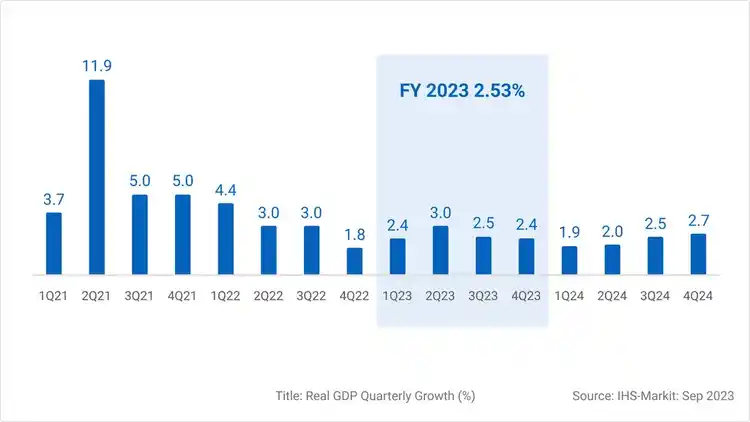
Global GDP projections continue to rise as exports and industrial production take a step back.
Key Macroeconomic Indicators Summary
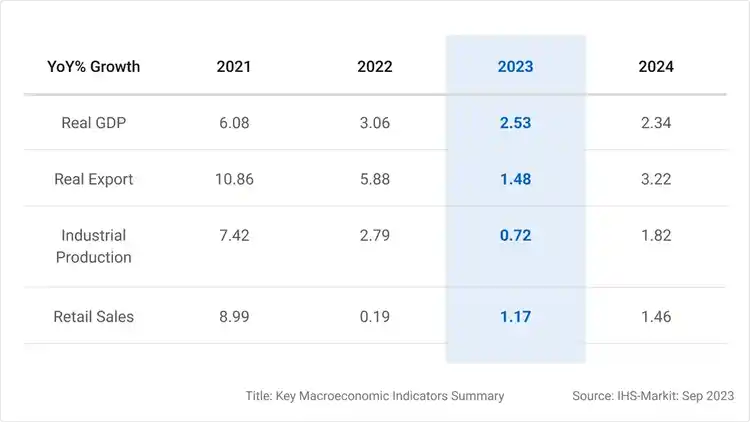
Real GDP Quarterly Growth
- Exports & Industrial Production have both seen decreased forecasts as demand remains weak
- Retail Sales forecast has remained flat from previous months
Global purchasing power dips slightly but global inflation rates continue to decline
Purchasing Managers’ Index (PMI)
- Global manufacturing PMI rose slightly to 49.1 in September, up from 48.7 in June, staying below the 50.0 mark for the seventh straight month
- China’s manufacturing PMI has shown growth above neutral for the previous two months as new export orders and manufacturing ramps up
Inflation Rate
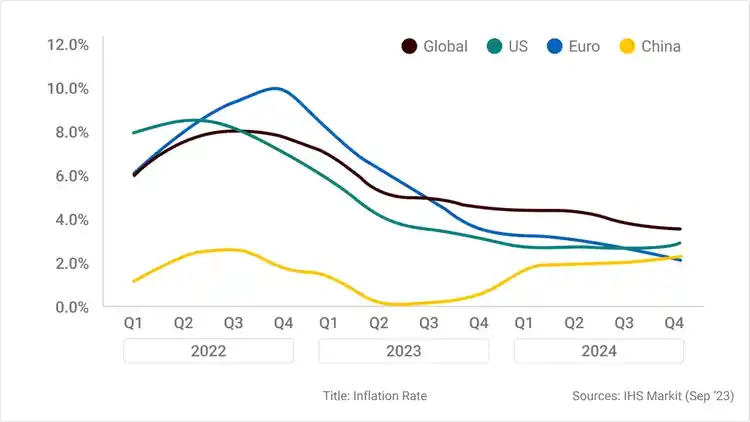
- The global annual inflation rate is expected to reach 5.7% in 2023, and drop to 4.16% in 2024
- Inflation rates are easing down globally and regionally which points at easing prices
- US inflation rate is expected to ease down from 4.1% to 2.7% in 2024
2023 GDP Outlook
Global GDP projections continue to rise as exports and industrial production take a step back.
2023 Real GDP Forecast YoY(%)
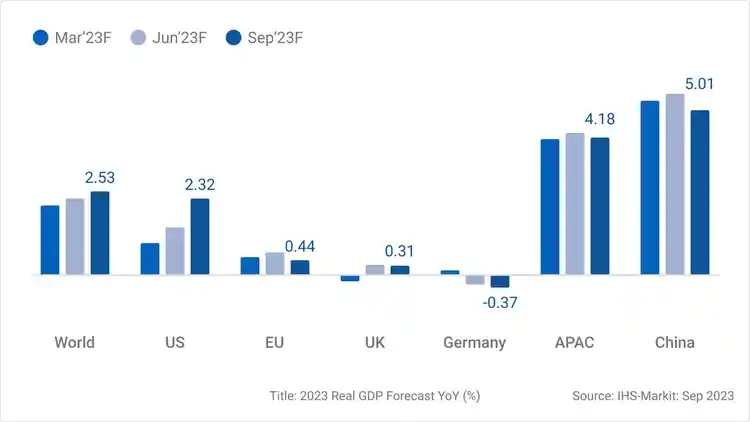
- World GDP growth has been updated positively as macro conditions continue to improve globally
- US GDP growth projections have increased, marking a more optimistic Q4 than in previous months in addition to a stronger global outlook for the year, however China saw a decrease in GDP growth projections, offsetting overall growth slightly
Air Freight Market Update & Trends
Year-to-date 2023 demand continues to decline but has begun to level off, rates continue to decline
Demand Vs. Capacity
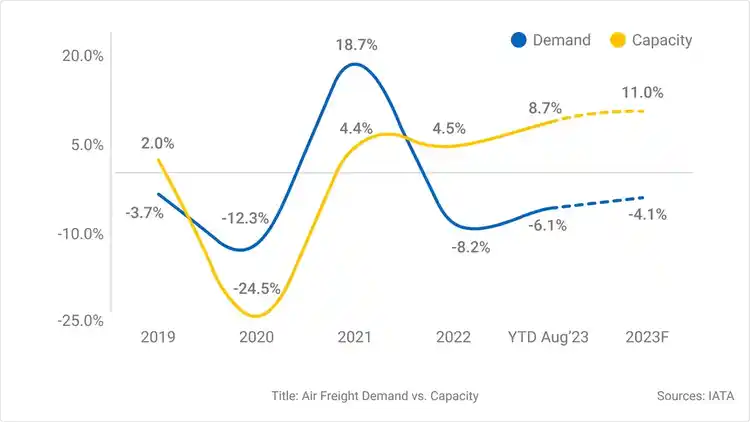
- IATA forecasts air cargo demand decline to be -4.1% in 2023 year-over-year
- Year-to-date 2023 IATA demand is at -6.1% and capacity has grown at +8.7%
- The weaker air cargo demand is a result of continued high inventory levels, further increases in capacity and the relative pricing between air and ocean shipping has driven some mode shifting
Rates
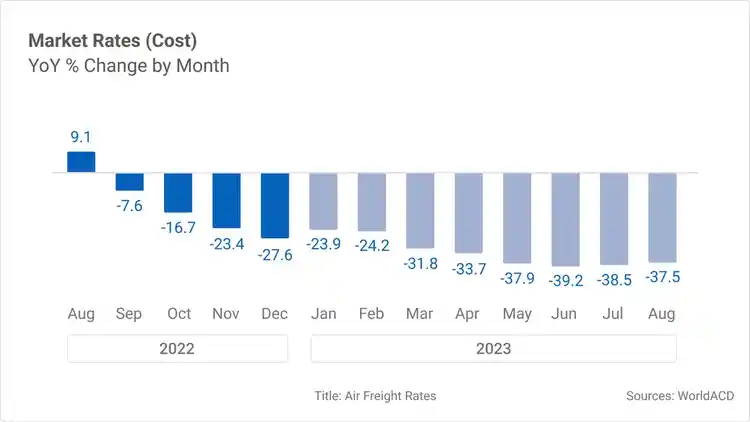
- Continued soft demand and the ongoing influx of capacity continue to drive rates down
- Expect rates to continue to decline as capacity continues to grow relative to the previous year, rates continue to decline but remain significantly above 2019 levels
International Air Freight Industry Trends
The Air Freight market has stabilized with positive macro trends and improving capacity
Market Stabilization
- The overall market remains relatively stable, air cargo demand’s decline has flattened out and even shown growth in recent months (+1.5% year-over-year in August)
- Capacity growth continues to outpace demand, with international belly capacity recovering close to 2019 levels
- Market rates continue to decline but have slowed and been mostly flat from May, still elevated from pre-pandemic levels
- August rates are about 35% higher than the same month in 2019
Manufacturing Output, Inflation and Regional Growth
- Manufacturing output and new export orders improved slightly in August, still below the neutral mark but indicating a slower decline in the global goods trade
- The US registered increased inflation in August, up to 3.7%, marking two months of growing inflation after thirteen months of decline
- Growth in demand occurred in most all major trade lanes in August, with North America to Europe/APAC registering slight increases from the previous month and Europe to Asia growing 8.8% year-over-year in August
E-Commerce Export Growth
- Low value e-commerce air export growth ex-APAC continues to buoy overall demand in the air cargo market
- High volumes from large exporters in addition to high tech product launches creating a spike in export demand from China, Vietnam and other APAC countries, creating positive year-over-year demand growth by the end of Q4
North America Air Freight Industry Trends
The North American Air Freight market has tightened with favorable undercurrents and headwinds
Domestic Market Outlook
- The overall market has flattened and the second half of 2023 resembling the first half’s performance with a slight peak surge in Q4
- Capacity maintains its upward trend while consumer demand remains relatively soft, presenting a case for a downward trend in rates
- Mexico has become the number one trading partner to the US due to global manufacturers diversification of supply chains with Nearshoring
Technological and Labor Issues
- Finding and retaining workers skilled in data analytics, data optimization, and data automation, etc. has created a talent shortage
- For shippers, the ongoing shortage of truck drivers in the US spurs concerns of service delays and increased costs from carriers
- Increasing cyberattacks impact supply chain network through barcode reader or IoT (Internet of Things) within operations and risks may become compounded as nearshoring is explored
Economic and Supply Chain Factors
- The US economy per the Federal Reserve shows GDP 4.9% growth in Q3 evidenced by retail sales declines are moderating, and destocking is running its course
- Inflation concerns and tighter consumer spending may delay purchases until certain peak events like online sales events
- Less-than-truckload (LTL) contractual rates are holding firm, with some shippers experiencing out of cycle increase shipping from carries who absorbed an abundance of Yellow freight
- Index of Consumer sentiment fell back about 7% this October following two consecutive months of very little change
Have questions? Speak to an air freight expert.
Ocean Freight Market Update & Trends
Recessionary concerns decrease global demand, capacity reduced to prevent further rate decreases
Demand
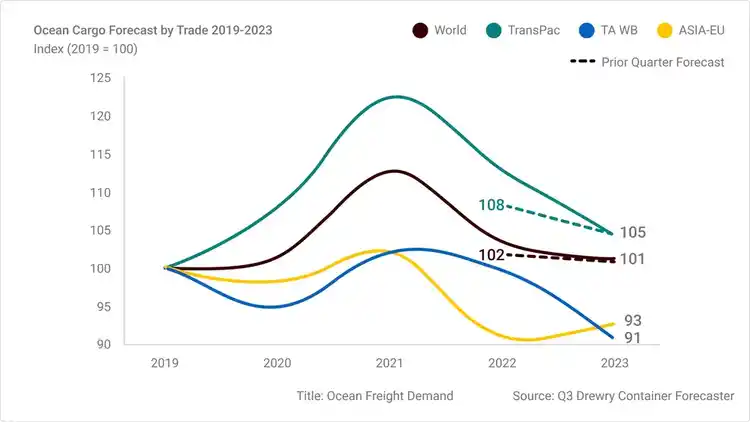
Situation:
- Global economy experiencing lingering inflation and higher interest rates
- Energy prices on the rise
- Inventories remain static, with shippers failing to reduce levels reached during the pandemic, partially due to a consumer shift from goods to services
Impact:
- Consumer Demand continues to decrease, again, due to such factors as inflation, static inventories and higher energy costs.
- The Israel-Hamas conflict triggered a 4% increase in bunker prices.
- Conditions point to an atypical 2023 peak season.
Capacity
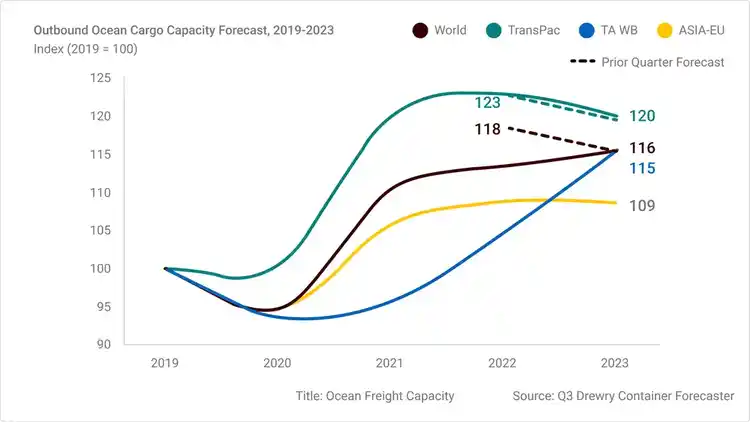
Situation:
- Weak demand environment persists
- Scrapping insufficient to have an impact
- Newbuild deliveries continue as carriers press on with green fleet transition
Impact:
- Although Drewry’s Q3 report shows slight capacity decreases vs Q2, newbuild capacity is still coming online for the remainder of 2023.
- Unless significant actions are taken to offset the new capacity, Drewry is forecasting substantial overcapacity globally in 2024.
- Carriers continue to blank sailings, slow-steam and change service offerings to try and absorb capacity.
Rates
Situation:
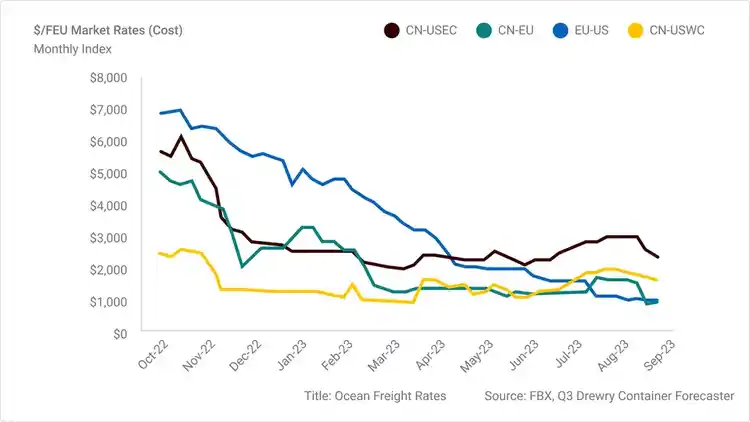
- Significant decline in rate level persists
- 3Q23 Drewry forecasts -33.1% decline in average global FEU Rate year-over-year between 2023 and 2024 (-33.2% 2Q23)
- 3Q23 Drewry forecasts -40.6% decline in average East-West FEU Rate year-over-year between 2023 and 2024 (-42.5% 2Q23)
Impact:
- Global freight rates have declined by around 75% from their peak in 2Q22. Although rates were buoyed briefly in a few trades, this was mostly due to trade-specific events like port labor issues, drought conditions, and a brief surge of peak season volumes.
- Carriers must take actions to reduce capacity to minimize the rate decline.
Overcapacity expected in the market in Q4 of 2023 and through 2024. Rates are likely to decline and service reliability may suffer as a result.
Newbuild Capacity Injection
-
Record Capacity coming into the market:
-
2023 has already seen almost 1.5 million TEUs of newbuild capacity delivered by shipyards, with 2024 forecasted to see 3 million TEUs delivered
-
Drewry’s latest Supply/Demand Index for 2024 is 74.3; The lowest ever Drewry S/D Score
- This score indicates significant overcapacity in the market through 2024
- Drewry S/D Index: 100 = Equilibrium; <100 = Overcapacity
-
-
Impacts of Newbuild Capacity:
- Declining rate levels
- Increased carrier capacity management
- Green Fleet transition
Carrier Capacity Management
-
Drastic actions to reduce capacity are on the horizon as rates continue to fall
- The difficult question to answer is – When will carriers start taking significant actions?
-
Carriers, so far, are not scrapping older vessels at the rate expected considering the amount of new capacity being introduced – But there are other potential ways to reduce available capacity
- Delaying Newbuild Deliveries – Per Drewry, this is unlikely as carriers want to press on with green fleet transition, and start realizing return on investment
- Even Slower Steaming – Drewry expects average vessel speeds to decline further in 2024
- More Scrapping – Drewry is forecasting a roughly 600% increase in TEUs scrapped in 2024 vs 2023
Green Fleet Transition
- Following the latest Marine Environment Protection Committee hosted by the International Maritime Organization (IMO), a revised strategy was proposed including a commitment to reducing GHG emissions to a Net Zero level* “by or around” 2050 (previous target was 50% reduction)
- Currently – Only 3.5% of the active global containership fleet are alternative fuel capable
- However – 95.8% of the current orderbook is for alternative fuel vessels
- There are concerns in the industry about the availability of the alternative fuels required to power these vessels, which is driving many carriers to diversify their orderbook across LNG, Biofuel and Methanol powered vessels
* compared to 2008 levels
Have questions? Speak to an ocean freight expert.
Customs & Trade Compliance Trends
Focus on data transparency, sustainability and enforcement activities are shaping global trade
Growing Interest in Nearshoring
- Nearshoring is changing trade flows due to geopolitical risks that have led to import tariffs, export controls, and other forms of protectionism.
- Mexico pitches tax breaks for companies that relocate operations to Mexico, targeting major export industries such as car making and semiconductors.
Preventative Measures Against Forced Labor
- In July and August, Customs and Border Protection (CBP) targeted 708 entries valued at more than $175 million for suspected use of forced labor in the production process, including goods subject to the Uyghur Forced Labor Prevention Act (UFLPA) and Withhold Release Orders.
- CBP could begin detaining imports of gold and minerals, and products incorporating them, under the Uyghur Forced Labor Prevention Act and asking importers to trace these items and materials back to their origin.
- The European Union is moving forward to prevent marketing of products made with forced labor on the EU market and requiring destruction of such products. The amended regulation has not yet been confirmed but once in position the EU will start final steps to shape the regulation.
Continued Import Controls
- 301 Exclusions - United States Trade Representative (USTR) has extended all current Section 301 exclusions that were due to expire on September 30, 2023. They will now expire on December 31, 2023.
- A 200% additional duty on aluminum and aluminum products from Russia continues as a step toward ensuring the viability of the US aluminum industry.
Have questions? Speak to a customs brokerage expert.
Global Logistics & Distribution Trends
Contract logistics & warehousing continue to be in high demand
Contract Logistics Market Growth
Contract Logistics Continues to be Poised for Growth
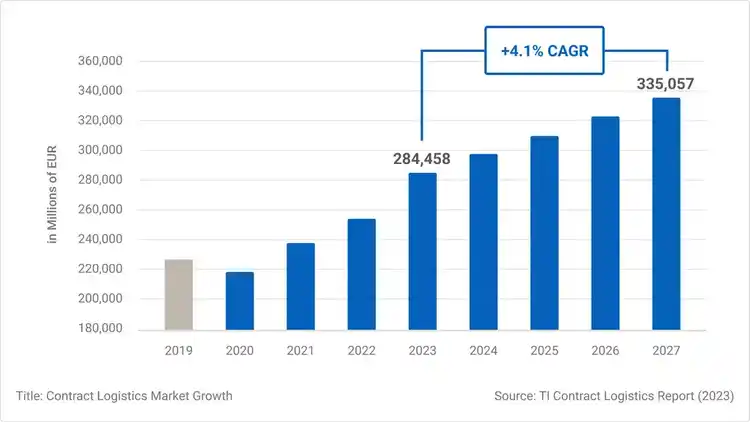
- Contract logistics growth potential continues to remain high, as only 30% of the market is currently outsourced and continues to increase
- The global contract logistics market continues to grow (4.1%) faster than global GDP (2.7%) across the regions
- Growth in 2024 is expected to be 4.4%
The Outlook for Outsourcing Logistics Functions Remains Strong
- 56.6% of 3PL respondents in a recent survey say they expect retailers to outsource more logistics functions
- 71.7% of respondents expect multi/omnichannel retailers to be the most likely to outsource logistics functions
Shifting Strategies
- Potential for continued supply chain disruption and uncertainty due to geopolitical tensions
- Companies are beginning to diversify where they manufacture goods to mitigate supply chain disruptions
- Additionally, nearshoring to Mexico is increasing as foreign direct investment rose 5.8% from a year earlier in May
Have questions? Speak to a logistics expert.
More from UPS Supply Chain Solutions
UPS Freight Services
At UPS SCS, we’re here to simplify shipping freight. Find the freight service that’s right for you and get your freight moving in the UPS Forwarding Hub.
Latest News
Read the latest freight and logistics news and market updates from the world of supply chain.
The UPS® Forwarding Hub
Our all-in-one customer portal lets you get and compare quotes, book and track shipments all on one modern, easy-to-navigate platform.